With hundreds of walks to download and print, free, it also has books of walks, contact details for all the walking groups in the county and much more. Whether you want to walk on your own or with a group all the information is there in one place.
John said ‘There is so much walking information on the web but it is difficult to find. Walking in Gloucestershire, part of the Walking in England suite of websites – one for each county in England, has brought it together in one place so whether you are walking from home, or away on holiday, you will be able to find a walk suitable for you’.
With walks from half a mile to twelve miles plus long, and a note of suitability for pushchairs and wheelchairs, everyone can find a walk to enjoy.
So home or away, check out the websites and get walking!
You may have seen Slow Ways featured on both BBC News and ITV News on October 16th? “Slow Ways…seeks to elevate the position of walking in our national conversation, to be seen not just as a worthy, healthy hobby but part of our national transport infrastructure”.
Slow Ways in a snail shell
Slow Ways is a project to create a network of walking routes and footpaths that connect all of Great Britain’s towns and cities as well as thousands of villages.
Using existing footpaths, people will be able to use the Slow Ways routes to walk between neighbouring settlements or combine routes for long distance journeys.
During lockdown 700 volunteers from across the country collaborated to produce a first draft of the Slow Ways network, creating a stunning Slow Ways map in the process. This incredible effort has led to the creation of 7,500 routes that collectively stretch for over 110,000km.
While COVID-19 has forced millions of us to stay at home and indoors, that hasn’t stopped us from being collaborative, imaginative, creative and productive.
We are currently working on building a website that will host all of the Slow Ways routes information and hope to launch that later this year.
All of the routes information that we collate will always be free to browse, search, view, share, download and enjoy.
When you move from America to England there are things you appreciate in a special, deep way only made possible by being raised bereft of them. The NHS is one that springs to mind. Also curry, sarcasm and footpaths.
When I lived in the mountains of North Carolina, surrounded by hundreds of acres of beautiful forest, it was all off-limits to me, except for the area set aside as a national park. There, you can’t walk through privately owned land. Unless you risk being prosecuted for trespassing, or possibly being shot at. Meaning unless you know the landowner, all you can do is look from a distance.
The missing miles of footpaths
In England the footpath network contains paths dating from 5000 BC, used by Neolithic people to move from place to place. Some date from the Romans, and some from Anglo Saxon times. Given the prevalence of long barrows and other sites sacred to Neolithic humans in this area, it is likely that some of the paths we enjoy were walked on many thousands of years ago. I think that is pretty marvellous. Our right for free access these footpaths has been fought for by the Ramblers, established in the 1930s to protect the rights of people to access the countryside.
Obviously a lot has changed in the last several hundred years, and the Ramblers recently pored over old maps, square kilometer by square kilometer to find lost footpaths. What they found was shocking. There were over 49,000 miles of historical footpaths missing from modern maps, almost a thousand miles in Gloucestershire alone! This represents almost a third of the footpath network in England.
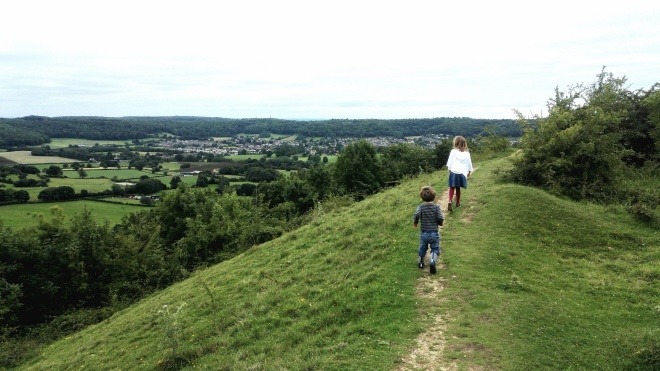
Walking a local footpath
Finding and reinstating
The government has given a deadline of January 1st 2026 to re-map the routes and preserve them. This seems like a long way away but will be upon us before we know it. This deadline was established as part of the Countryside and Rights of Way act of 2000. However, as the clock ticks down the government has taken no action towards mapping and preserving historic footpaths. Of course at the moment they have quite a lot of other things on their plate.
Some of these paths have been:
developed over or
legally extinguished or
are small fragments
The Ramblers Association – Don’t Lose Your Way
The Ramblers are prioritizing paths which add value to the footpath network, such as
completing circular routes
resolving dead ends
adding walking to areas without many off-road walking options.
They are looking for volunteers to help with this mission which they’ve named Don’t Lose Your Way, by finding and mapping these routes, and where appropriate applying for them to be restored.
For more information on how you can help with this work, you can go to the Ramblers Website where there is an extensive FAQ.
These footpaths have been established over many hundreds, or indeed thousands of years, and are easy to take for granted, but once they are gone they are gone forever. To join the South Cotswold Ramblers see their website
Jessica Burchfiel
Piers Court Footpaths
I have been asked by the Owners of Piers Court to include this text for publication.
The lockdown in recent months has been challenging for all of us. As a result, Piers Court has experienced a big increase in the footprint on its grounds. Whilst the majority of walkers have respected that Piers Court is a private property with public footpaths with a public right of way (PROW), some sadly have assumed that Piers Court is a public park which has resulted in undesirable consequences for the new owners of Piers Court (damage to property, unpicked dog fouling and blatant trespass). Whilst such abuse may have been due to insufficient signage and a lack of awareness by some walkers, the owners of Piers Court would like to kindly remind walkers that the use of the PROW is subject to a statutory code where the rules are laid out by law and not by the owners.
Now that the lockdown is being slowly relaxed, the owners have placed signs over the grounds of the property to guide walkers to the footpaths with PROW. Additionally, the owners have placed signs indicating where there are permissive footpaths which walkers can use at the owners’ discretion despite the absence of a PROW. All accessible footpaths (PROWs and permissive) have been cleared and widened so as to make walks more enjoyable. Furthermore, a viewing point has been cleared to enable walkers to take a short break and to enjoy the vantage point from the permissive footpath over the Church, Berkeley Castle and the Severn Estuary. The new owners would kindly request that walkers in the field which is furthest from the house (near Yercombe Lodge) use the permissible footpath on the edge of the field rather than the diagonal PROW. This polite request is for the purpose of limiting the damage to the crops (hay). The owners have a contract in place with a local farmer Chris Morgan who takes care of the fields in return for the hay yield. The owners are therefore requesting that walkers be community-spirited.
In addition, the owners of Piers Court are investing a substantial sum of money in restoring the original Parkland and planting new trees to replace those that are coming to the end of their life. This would be for future generations to enjoy.
The owners are close friends with Evelyn Waugh’s family, in particular with Septimus (Evelyn’s youngest son) who vividly remembers his early childhood at Piers Court and who is currently assisting the new owners. Given that it is the 75th anniversary of the publication of Brideshead Revisited (which was written at Piers Court), the owners will be inviting some of the Waugh family to Piers Court to mark the occasion.
Helen Lawton.
“All opinions and information expressed in e-News items and on the website are those of the contributors and not necessarily of the Parish Council”