Did she or didn’t she?

Did Jackie Weaver have the authority?

There has been much in the news recently about America, COVID-19, Boris, Schools, and a ton of other things for us to talk about. But, there has really only been one big question that has occupied my mind for the last couple of weeks, and that is: Did Jackie Weaver have the authority?

The Parish Council is the bedrock upon our whole system of government is built, without people like those in the Handforth Parish Council giving up their time freely for others is it too much to say we could descend into the depths of anarchy?

Maybe a tad, but as an ex Parish Councillor myself I do know that any small Council needs a common purpose, a will to co-operate and definitely respect for each other. Dibley does come into mind sometimes when discussing some items at a meeting but this is when you also know that you give up YOUR time for the good of YOUR COMMUNITY and what the Parish Council decides is noticed by County and District councillors and it DOES make a difference.

I would encourage anyone who lives in Stinchcombe, to think about taking a stint on the Parish Council. You do reap more than you sow and when you leave you will have a much great depth of understanding of the affairs of the community that you live in.

The Answer

OK, enough of the above, I have searched and searched the internet and finally found a blog written by David Allen Green who is a contributing Editor at the Financial Times.

On his blog “Did Jackie Weaver have the Authority?” he says, quite explicitly….Well, you will just have to read it yourself!


Laptops for Schools

Dursley Rotary Club : Make a difference and give a laptop

Dursley Rotary Club is collecting unwanted computers, laptops or ipads. Following wiping and reprogramming, these can be given to pupils at local schools who are in desperate need of them.  At the moment Cam Everlands Primary School seems to have the greatest need.

Cam Everlands also has the facility themselves to carry out and guarantee the necessary “cleaning” and “refurbishing” of all donated computers.

If you wish to donate one please contact:

  • Russ Holloway 542159
  • Chris Wellings 543110

Many Thanks
Russ


Valentine’s Day

The Legend of St. Valentine

The history of Valentine’s Day—and the story of its patron saint—is shrouded in mystery. We do know that February has long been celebrated as a month of romance, and that St.Valentine’s Day, as we know it today, contains vestiges of both Christian and ancient Roman tradition. But who was Saint Valentine, and how did he become associated with this ancient rite?

The Catholic Church recognizes at least three different saints named Valentine or Valentinus, all of whom were martyred.

Emperor Claudius II

One legend contends that Valentine was a priest who served during the third century in Rome. When Emperor Claudius II decided that single men made better soldiers than those with wives and families. Therefore he outlawed marriage for young men. Valentine, realizing the injustice of the decree, defied Claudius and continued to perform marriages for young lovers in secret. When Valentine’s actions were discovered, Claudius ordered that he be put to death.

Saint Valentine of Terni

Still others insist that it was Saint Valentine of Terni, a bishop, who was the true namesake of the holiday. He, too, was beheaded by Claudius II outside Rome. Other stories suggest that Valentine may have been killed for attempting to help Christians escape harsh Roman prisons. Prisons where they were often beaten and tortured.

According to one legend, an imprisoned Valentine actually sent the first “valentine” greeting himself after he fell in love with a young girl. Possibly his jailor’s daughter, who visited him during his confinement. Before his death, it is alleged that he wrote her a letter signed “From your Valentine,”. The expression that is still in use today.

Although the truth behind the Valentine legends is murky, the stories all emphasize his appeal as a sympathetic, heroic and—most importantly—romantic figure. By the Middle Ages, perhaps thanks to this reputation, Valentine would become one of the most popular saints in England and France.

Valentine’s Day: A Day of Romance

During the Middle Ages, it was commonly believed in France and England that February 14 was the beginning of birds’ mating season, which added to the idea that the middle of Valentine’s Day should be a day for romance.

The English poet Geoffrey Chaucer was the first to record St.Valentine’s Day as a day of romantic celebration. In his 1375 poem “Parliament of Foules,” he wrote;
“For this was sent on Seynt Valentyne’s day / Whan every foul cometh ther to choose his mate.”

Valentine greetings were popular as far back as the Middle Ages. Though written Valentine’s didn’t begin to appear until after 1400. The oldest known valentine still in existence today was a poem written in 1415 by Charles, Duke of Orleans. He was imprisoned at the time in the Tower of London following his capture at the Battle of Agincourt. (The greeting is now part of the manuscript collection of the British Library in London, England.) The Duke of Orleans wrote to his wife:

Je suis desja d’amour tanné, Ma tres doulce Valentinée

This translates roughly as, “I am already sick of love, my very gentle Valentine”

The Oldest Valentine
The oldest known Valentine we know is a poem, written in 1415 by the Duke of Orleans, Charles, who wrote it to his wife during his imprisonment in the Tower of London after he was captured during the Battle of Agincourt – Source BBC

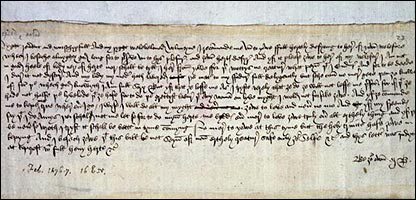
In 1477 a letter was sent by one Margery Brews to her fiancé John Paston. In this letter Margery describes John as her “right well-beloved Valentine”.

well-beloved Valentine
Margery addresses John as ‘right well-beloved Valentine’: Add MS 43490, f. 24r

Shakespeare’s Hamlet

By the 17th century Valentine’s Day gets a mention in William Shakespeare’s Hamlet, when Ophelia is given the lines:

However, it was in the 18th century that the most familiar Valentine’s poem made its first appearance. These lines, found in a collection of nursery rhymes printed in 1784, called Gammer Gurton’s Garland: Or the Nursery Parnassus :

While this was the first appearance of the poem in this form, its origins reach back to Sir Edmund Spenser’s 1590s epic, The Faerie Queene. This featured the lines:

This Valentine’s Day

So, on this Valentine’s Day, however you choose, whether by card, by flowers, or just by poem, send your love to someone special.


Chinese New Year 2021

When is the Chinese New Year?

The Chinese New Year 2021 falls on Friday, February 12th, 2021, and celebrations culminate with the Lantern Festival on February 26th, 2021.

How long is Chinese New Year?

16 Days. Celebrations last up to 16 days, but only the first 7 days are considered a public holiday (February 11th–17th, 2021).

What is the 2021 Chinese zodiac?

Chinese New Year marks the transition between zodiac signs: 2021 is the year of the Ox; 2020 the year of the Rat.

The Ox is the second of all zodiac animals. According to one myth, the Jade Emperor said the order would be decided by the order in which they arrived to his party. The Ox was about to be the first to arrive, but Rat tricked Ox into giving him a ride. Then, just as they arrived, Rat jumped down and landed ahead of Ox. Thus, Ox became the second animal.

The Ox is also associated with the Earthly Branch (地支 / dì zhī) Chǒu (丑) and the hours 1–3 in the morning. In the terms of yin and yang (阴阳 / yīn yáng), the Ox is Yang. In Chinese culture, the Ox is a valued animal. Because of its role in agriculture, positive characteristics, such as being hardworking and honest, are attributed to it.

The Monster and New Year’s Eve

In ancient times, there was a monster named Nián (年). It usually lives at the bottom of the sea and comes up once a year to feast on animals and humans. On this day, the villagers would all escape into the mountains.

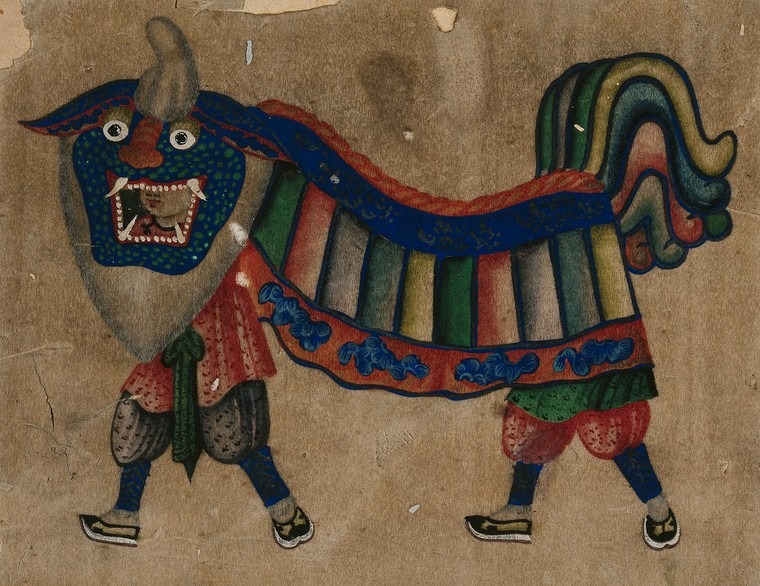
Two figures parade in a Chinese dragon train. Painting by a Chinese artist, ca. 1850.. Credit: Wellcome Collection. Attribution 4.0 International (CC BY 4.0)

One year, a beggar came to seek shelter, but everyone was hurrying away. Only an old woman took him in and he promised to chase Nian away. He busied himself with decorating the homes.

At midnight, Nian lumbered in but stopped short when it saw the red paper on the doors. As it roared in anger, firecrackers suddenly sounded and it trembled in fear. When it saw the beggar, dressed in red, laughing at it, it could only run away.

The villagers came back the next day and were pleasantly surprised that the homes were all still standing. They realized that loud noises and the color red were Nian’s kryptonite.

This is why, on New Year’s Eve, families eat dinner in their homes fortified by red decorations. At midnight, firecrackers are sounded. In addition, people will wear new and festive red clothing to celebrate.

Further reading see Chinese New Year


The Havoc of being Hacked

The Hook

This morning I received an email proposedly from a friend. It was a very good example of the utter havoc that a friends phone / computer being hacked can cause.

1st email from a the friends email address.

Good Morning,
How are you doing today?
I need a favour from you, i’m unavailable on phone, kindly let me know if you are online.
Await your swift response.

2nd email from an email address which is the same name but now with a new gmail account

I am sorry for bothering you with this mail, i need to get an Amazon gift card for my Niece, Its her birthday but  I can’t do this now because I’m currently out of reach and i have a little issues with my amazon account, can you get it from any store around you or try buying online for me? I’ll reimburse you hopefully next weekend.
Waiting to read back from you

At this point, having now come fully awake, alarm bells rang. They should have been ringing after the 1st email, but I plead lack of coffee. If I had continued to engage with my “friend”, the best outcome might have been that I would send an Amazon gift card £100 and lost the money, the worst might have been that my computer would have been infected as well….

What must have happened

First the hackers must have taken control of my friends computer or the email account. In this case, it was the computer. The most common ways are:

  • Emails containing viruses and malware – This is one of the most popular methods of spreading malware hidden in an attachment in the email. Once the attachment is opened, the malicious software executes and/or downloads onto the computer that receives it.
  • Emails with links to malicious websites – Often referred to as phishing these emails attempt to emulate legitimate emails from well-known organisations that the receiver would tend to trust such as a bank. The html links lead to fake websites which try and trick the user entering sensitive information such as passwords and banking details. Sometimes these websites also attempt to install malware, viruses or spyware on the recipient’s computer.
  • Social networking pages – People tend to let down their guard and be less wary on social networking sites. With this method, a fake profile entices real users into following links to malicious websites or giving up sensitive personal information.
  • A phishing scam that asks you to “confirm” your password. These types of scam emails can be convincing. But you should never respond to any unexpected message that asks you to verify your password, account numbers, addresses, or any other information of this kind.

Once a hacker has control of your computer, they can wander around at will and look at all your files, your stored passwords, your whole life….

What to do when you have been hacked

Isolate Your Computer

In order to cut the connection that the hacker is using to “pull the strings” on your computer, you need to isolate it so it can’t communicate on a network. Isolation will prevent it from being used to attack other computers as well as preventing the hacker from continuing to be able to obtain files and other information. Pull the network cable out of your PC and turn off the Wi-Fi connection. If you have a laptop, there is often a switch to turn the Wi-Fi off. Don’t rely on doing this through software, as the hacker’s malware may tell you something is turned off when it is really still connected.

Inform the National Fraud Intelligence Bureau (NFIB)

Report a fraud to Action Fraud, by Tel 0300 123 2040 or using the on-line tool. You are then given a police crime reference number and your case will be referred on to the National Fraud Intelligence Bureau (NFIB), which is run by the police service. This have benefits when you might have to change any bank accounts and credit cards. Once you report to your bank and have a crime reference, you are indemnified against further losses. Check the GOV website Avoid and report internet scams and phishing.

Now Calm, Down and Assess the situation

Having done the important bits, just sit down and have a cup of tea. Make a list of things to do and people to talk to. It’s not the end of the world.

  • Your computer will have to be looked at by someone who knows what to do.
  • You might want to change ALL your financial passwords.
  • You need to contact your Internet provider and change ALL your online passwords.
  • You might want to contact all your email contacts that your email account has been hacked.
  • Talk to a friend or someone who can give you advice, help and support. After all, you have just been burgled!

Prevention is MUCH better that the cure

This is a case where prevention is MUCH better than the cure.

  • Every computer needs good and UPTODATE Virus/Malware. Think of it as insurance. You wouldn’t drive without insurance and you wouldn’t not have insurance for your house. So why penny pinch on insurance for your computer? Personally I use Malwarebytes, because I don’t find it too intrusive.
  • Use STRONG passwords (not dogs name) and also a PASSWORD KEEPER. A file called “passwords” is the first thing hackers will look for.
  • Be AWARE. Think of surfing the internet as swimming in the sea off the beach. One has to be aware of what your doing. It can be dangerous. Don’t touch / open / click unless you know who it came from and know what it is.
  • BACKUP everything. If your computer stops today, can you start again on a new PC tomorrow? In these days of “Cloud” computing all your files should be backed up somewhere in the cloud. There are many providers who would do this for you. (Google/Amazon/Microsoft/Dropbox etc)

I hope you find the above of use, and if you have any tips, suggestions or improvements for this article please feel free to use the comments section below.


Stinchcombe United Charities

Stinchcombe United Charities are looking for a new Trustee

Stinchcombe United Charities have been operating since 1895 and over that time has helped countless Parishioners with support. It has also helped many Stinchcombe students through the Matthew Tyndall Educational Foundation with Grants to purchase books in order to assist them with their studies.

Mrs Clare Cooke has retired as Trustee from the Charities. Clare joined as Trustee in 1987 and for the last 15 years has been Chairperson.

Whilst Clare has enjoyed working for the Charity, after 33 years, she feels that it’s time to step down and to make way for another Parishioner to step up and continue the Charitie’s work in Stinchcombe.

Are you interested in becoming a Trustee and helping people who are living in Stinchcombe when things get difficult for them?

You will be a Co-opted Trustee, in fact one of 5 Co-opted from Parishioners.

There are also 3 Nominated Trustees (usually) from the Parish Council, The Vicar of St. Cyr’s Stinchcombe is an Ex Officio Trustee  (currently, the Reverend Fiona Crocker)

The position of Trustee is not an onerous position, and usually involves meeting just once per year to administer funds to the Parish needy.

Please consider becoming a Trustee

Apply to Mrs Sharon Townend (Chairperson)
C/o the Clerk, Stinchcombe United Charities   Email


Will there be new nuclear build at Berkeley or Oldbury?

A real possibility by Chris Davies

Even though the nuclear power stations at Berkeley and Oldbury are currently being decommissioned, a new build at one of these sites is a real possibility. The Government’s Ten Point Plan for a Green Industrial Revolution includes new nuclear as part of the energy mix to achieve net zero carbon emissions by 2050.  The White Paper Powering our Net Zero Future published last December confirms the continuing role of nuclear energy.

Why Nuclear Power is Needed

Our electricity system is growing – the official estimate is that it will double in size by 2050. This is mainly because demand for low-carbon electricity in sectors like heat and transport will rise. For example, all these modern technologies need electricity

  • heat pumps used to heat buildings instead of gas
  • electric cars for charging instead of petrol
  • future transportation instead of diesel

The UK’s renewable electricity outpaced its fossil fuel generation for the first time in 2020 and could remain the largest source of electricity in the future. Renewable energy (wind, sunlight, water and wood) made up 42% of the total, compared with 41% from coal and gas plants and about 10% from nuclear. At present, we also have to import electricity from the continent via subsea connectors.

We will continue to need baseline power when renewable contribution is low e.g. in a winter cold spell when there is high energy demand, no wind and low energy from the sun. Various methods of achieving this are under consideration including fossil fuel plants with carbon capture, battery storage and nuclear power. 

Nuclear Technologies for the Future

The UK strategy for nuclear energy is based on a combination of:

The White Paper promises up to £385 million for an Advanced Nuclear Fund.  This will support the development of a UK SMR design and the building of an AMR demonstrator in the UK.

Large scale nuclear (2000 to 3260 MW)

The first generation of British Magnox reactors are now either being decommissioned or will shortly be decommissioned. The 2000 MW Sizewell B Nuclear Power Station (NPS) in Suffolk is the first of the new generation of pressurised water reactors. It started generation in 1995 and will continue for at least another 15 years.

The Government is “pursuing large-scale nuclear projects, subject to value-for-money”. Hinkley Point C NPS (3260 MW) in Somerset is currently being built by Electricite de France (EDF). It is is due to start generation in 2026. EDF plans to build a sister station Sizewell C, subject to finance agreement with the government. Horizon were planning to build an NPS at Wylfa in Anglesey, followed by one at Oldbury.  They are believed to be weeks away from pulling out of these projects due to an inability to agree finance arrangements.

Construction of large-scale nuclear power stations typically takes10 years and the cost is in the region £20bn to £25bn.

Small Modular Reactors (200 – 500 MW)

Small modular reactors (SMRs) will be manufactured at a factory and assembled on site.  They mostly use proven water-cooled reactors similar in design to current nuclear power station reactors, but on a smaller scale.  Rolls Royce, for example, use technology developed from their range of nuclear submarine reactors.  Innovative manufacturing techniques and modular construction should make SMRs faster to build than large-scale nuclear plants and potentially suitable for a wider range of sites.

Rolls Royce is leading the UK SMR consortium to develop a design specifically for factory manufacture of components at a centralised facility. The reactor unit is 16m high by 4m diameter, and will be transported by road, rail or barge. The estimated construction programme is 5 years.   

The Government believes that SMRs “have the potential to provide cost-competitive nuclear power as early as the 2030s”. The consortium is lobbying to build 16 SMRs over the next 20 years.  Although Rolls Royce’s nuclear base is at nearby Barnwood, they have not specifically mentioned Berkeley or Oldbury as possible sites.

Advanced Modular Reactors (c500 MW)

The Department for Business, Energy and Industrial Strategy (BEIS) are investigating AMR technologies.  These are defined as ones that use novel cooling systems or fuels that would offer new functionalities (such as industrial process heat). These reactors could operate at over 800°C. They would provide high-grade heat to be used in the efficient production of hydrogen and synthetic fuels.  As with SMRs, AMR designs aim to maximise the amount of off-site factory fabrication.

Phase 1 of a BEIS competition shortlisted the technologies of three companies for further development in Phase 2:

  • Tokamak Energy Ltd
  • Westinghouse Electric Co UK Ltd
  • U-Battery Developments Ltd

Tokamak Energy Ltd 

Tokamak Energy Ltd  is a private company of 100 staff based in Oxfordshire, are pursuing the goal of small modular fusion reactors. The fusion of positively charged particles at extremely high temperatures creates a soup of very fast moving electrically charged gas called plasma.  A tokamak is one of several types of magnetic confinement device being developed to produce controlled thermonuclear fusion power.

Conventional nuclear power is based on fission. The advantages of fusion, if it can be commercialised, are greater safety, inexhaustible fuels, zero carbon dioxide and no long-lived radioactive waste. Additionally, a fusion plant would be very compact compared with renewable technologies.

Last December the Government asked communities across the country to put forward proposals to host the UK’s prototype fusion energy power plant, known as STEP.  Prof Tom Scott of Bristol University gave a presentation at a recent meeting of the Berkeley Site Stakeholder Group. He is involved in a bid to bring the project to Oldbury or Berkeley.

Westinghouse Electric Co UK Ltd

Westinghouse is developing an AMR based on Lead-cooled Fast Reactor technology.  They are working with leading UK organisations to accelerate development and achieve commercialisation in the UK and globally.

U-Battery Developments Ltd

U-Battery is powered by a special “accident-tolerant” uranium fuel originally developed in the 1960s.  It is claimed to prevent the release of radioactive material, minimising the need for backup shutdown systems. This, combined with the reactor size and design, is supposed to make the technology inherently safer. Like the other shortlisted AMRs, U-Battery is a compact, modular system. It is aimed at energy intensive industries, including hydrogen production and at remote locations.

In Conclusion

The Government sees nuclear power as a vital part of the UK’s low carbon energy future, providing essential baseline power.  They are currently planning on one new large scale NPS and this is likely to be Sizewell C. They are investing in the development and commercialisation of modular reactors, both SMRs and AMRs.  Berkeley and Oldbury are being enthusiastically promoted as possible sites for one type of AMR, a STEP fusion demonstration plant. They may face competition from other locations, but if chosen would assist the local economy and provide useful employment.